
By Laura Bode
During a quick midweek dinner of Costco rotisserie chicken, fresh green beans and Kirkland Signature™ Organic Quinoa, I decided to play a game with my 5-year-old daughter. "If you were stranded in a desert and could eat only one thing, what would it be?" I asked her.
"Chocolate, silly!" she responded.
My response? Quinoa. I received puzzled looks from everyone at the table, but I was steadfast in my reasoning: Quinoa requires minimal water to grow and provides minerals and an abundance of easily digestible protein-factors that are very important to surviving life in the desert. Teasing aside, quinoa is an incredible food that I'm glad to have discovered, and I am even more excited that Costco has partnered with four amazing suppliers to produce the Kirkland Signature organic quinoa that my family can't seem to get enough of.
Where does it come from?
Quinoa was first domesticated about 5,000 years ago in the Andean region of South America. Peru, Bolivia, Ecuador and Chile were among the first countries to grow it. Today, Costco sources its quinoa primarily from Bolivia and Peru, says Kristen Hayes, a Costco dry grocery buyer. She explains that quinoa is sold in Costco locations around the globe. The U.S. is the largest consumer, followed by Europe and then Canada, she says.
Kirkland Signature organic quinoa is cultivated by traditional smallholder farmers (anyone who operates on 10 acres or less in Peru or Bolivia) who are committed to sustainably growing organic quinoa using the same farming techniques their ancestors did generations ago.
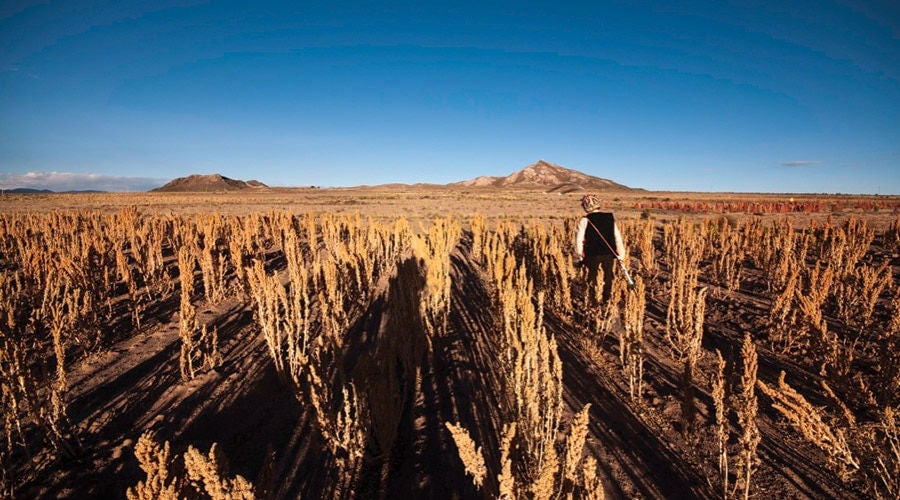
In Bolivia, farmers grow their quinoa near the Bolivian salt flats, explains Sergio Nuñez de Arco, CEO and co-founder of Andean Naturals, one of the main suppliers of Kirkland Signature organic quinoa. "No other crop will grow there besides quinoa, because of the altitude, salty soil and lack of water," he says. "You have to time the planting just right. A couple of weeks before the start of the rainy season, farmers dig holes about 8 inches deep to reach the trapped moisture from the previous year's rains. They drop the [annual] quinoa seeds, hoping this is enough moisture for the baby plants to grow until the rains come. The farmers plant the quinoa seeds a few weeks before the rainy season since it rains so little there. The same plot of land can only be used once for every two years in this ancestral practice of desert farming."
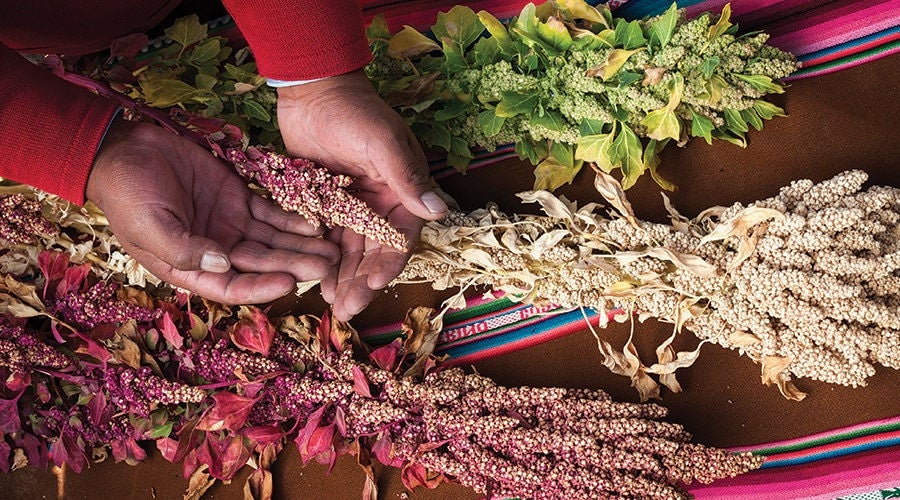
Once the plants have grown, they have pink, yellow, red or white heads. "Each is a different variety of quinoa, with different properties such as resistance to pests, drought, heat, etc. Farmers choose the best seeds for their fields, mixing varieties to maximize their chances of getting a good crop," Nuñez de Arco explains. "This makes a truly heirloom, biodiverse quinoa and not a monoculture of a single, industrially grown seed. Healthy seeds transmit their health to the consumer."
Quinoa seeds are planted in October, and harvest takes place in April. Well over 1,000 farms support Costco's demand for quinoa, says Chad Sokol, a Costco dry grocery buyer.
Sustainable food source
Quinoa is a very sustainable food source. Unlike rice, which requires about 7 feet of water each year to grow, quinoa needs only 8 inches. The United Nations was so impressed by this naturally gluten-free food that they designated 2013 the International Year of Quinoa in an effort to raise awareness of the nutritional, economical, environmental and cultural value of a food that has been cultivated for thousands of years.
Quinoa has become even more popular in recent years. "A convergence of trends in health and natural/organic foods, gluten-free foods, a promotion of whole grains and more openness to Hispanic and specialty foods came together," Nuñez de Arco says. "Also [as a major supplier] we came on the scene, able to aggregate the quinoa from thousands of smallholder farmers and provide a reliable, high-quality, [high-]volume supply needed for retailers to finally launch quinoa."
Nutritional powerhouse
The ancient Incas called quinoa "the mother grain" for a very good reason: It was thought to promote a healthy pregnancy and increase a new mother's milk production. Quinoa is a complete protein, meaning that it contains all nine of the essential amino acids that must come from food since our bodies cannot produce it. Experts like calling it a "superfood" for this reason.
"Quinoa's complete protein includes lysine, a vital amino acid that our bodies cannot produce on their own," Nuñez de Arco says.
According to the University of Maryland Medical Center, lysine appears to help the body absorb calcium and it also plays an integral role in the formation of collagen, which is important for bones, skin, tendons and cartilage. Various medical studies suggest that getting enough lysine might help to reduce outbreaks of cold sores and herpes, and it might help muscle tissue recover more quickly after a workout.
Quinoa has been classified by the National Academy of Sciences as one of the best sources of protein for vegetarians. It is also a digestible food source for those with wheat allergies or sensitivities.
Because the seeds are so tiny, I often double or triple the quinoa recipe when I make it, only to have an overflowing bowl I don't imagine my family will consume. But we always manage to, in the form of pancakes, stir-fries and soups, and there are hundreds of recipes for using quinoa—everything from apple cinnamon cheesecake and ice cream sandwiches to sushi, smoothies and scones.
I plan to serve kale the next time we play the "stranded in the desert" game. Another opportunity to impart more superfood wisdom to my family.
Freelance writer Laura Bode fills the consumer reporter slot with this behind-the-scenes look at a Costco program. Email questions about this article to buyingsmart@costco.com.
QUINOA CUISINE
HERE ARE some quick and easy ways to incorporate quinoa into your diet.
- Toasted quinoa is simple to make and adds a tasty crunch to cereals, parfaits and granolas.
- Add cooked quinoa to eggs. The new flavor and texture is a nice change from the usual scrambled eggs and toast.
- Mix cooked quinoa with quick oats and sprinkle in some fresh berries, milk, pepitas or sunflower seeds.
- Add quinoa to soups or chili-as you prepare them-to bulk up your meal with extra protein and nutrition.
- Toss cooked and cooled quinoa with pasta or salads.
-LB
Captions: Main image Left: Farmer Efigenia carefully chooses and saves heirloom quinoa seeds to plant next year.
Bottom right: At 12,000 feet in altitude on the desert Andean plateau, Miguel Huayllas walks the organic quinoa field he cares for.
Photo Credits: R. Ruiz/Andean Naturals