

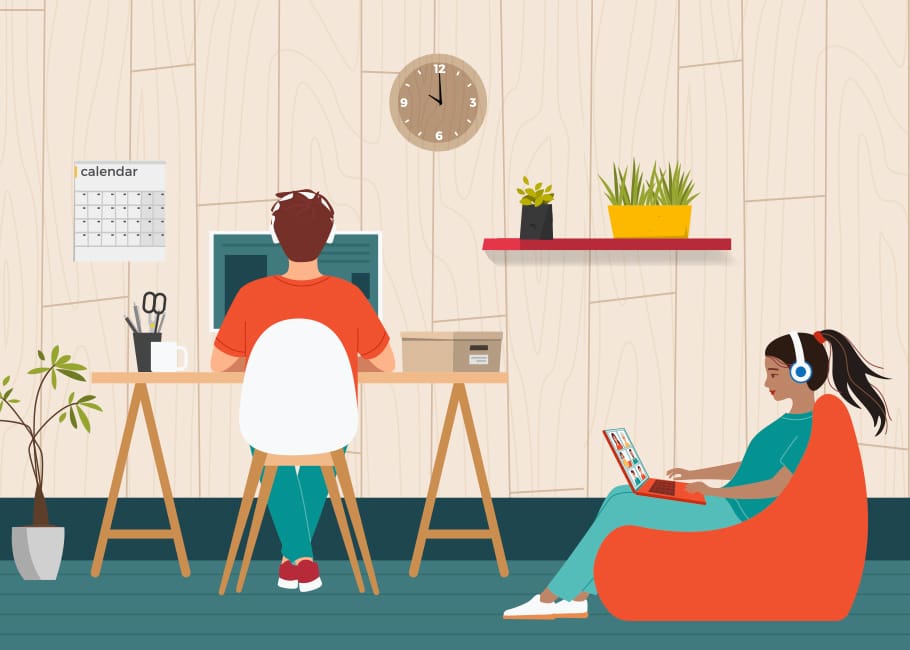
Workspace for two
Tips to successfully share home office space with a partner
by ROSIE WOLF WILLIAMS
The last few years have changed the way we do business, and many brick-and-mortar businesses are making the change to fully remote or hybrid working. In fact, a recent study by tech communications company Owl Labs found 83% of survey participants who work from home say their productivity level is the same as or at higher levels than when they were working in the office.
If you are in this situation (or headed there), one partner in your home may already have an established office space, while the other does not. Or both partners may find themselves working from home for all or part of their employment. In both scenarios, couples will have to make adjustments.
Make a game plan
"One approach to solving the problem would be to set up clear boundaries and ground rules for the workspace," says Dr. Alejandro Alva, founder and chief medical officer at Pacific Neuro-psychiatric Specialists in Orange County, California. He says this may involve discussing things such as storage space, noise level, work hours and/or other preferences. "It is important to communicate openly with your partner about any issues that may arise and work together to find a solution," he adds. These might include designating certain times of day when each person can have the space to themselves, or alternating days if possible. It is also important to communicate openly about expectations, needs and concerns.
Professional organizer Phaedra Studt, owner of Practical Possibilities in Chicago, agrees. "I work from home when I'm not working with my clients in their homes," she says. "Pre-pandemic, my husband worked primarily in the office." She says that when he began working from home, she was initially frustrated because she went from having a quiet place to work, to having her work situation disrupted by countless phone calls that her husband would take. "I could sometimes relocate to another place of the home, but my desk had my second monitor and my scanner," she adds.
The couple came up with solutions. Studt began using noise-canceling headphones with some music to help her focus. She also let her husband know the days that she would need the office and asked him to relocate for the day: "I started putting these days on the calendar so he [knew about them] before they came up."